 Bird App
Bird of the day
Jabiru
Jabiru mycteria
The jabiru ( or ; Jabiru mycteria) is a large stork found in the Americas from Mexico to Argentina, except west of the Andes. The only member of the genus of the same name, it is most common in the Pantanal region of Brazil and the eastern Paraguayan Chaco. It sometimes wanders into the United States, usually in Texas, but also reportedly in Mississippi, Oklahoma and Louisiana. The name comes from the Tupi–Guaraní languages and means 'swollen neck'.
The jabiru is the tallest flying bird found in South America and Central America, often standing nearly the same height as the flightless and thus much heavier greater rhea. For the continent, it also has the second-largest wingspan, after the Andean condor (that is, excluding the great albatross occasionally found off the coast of southern South America). The adult jabiru is 120–140 cm (47–55 in) long, 2.3–2.8 m (7.5–9.2 ft) across the wings, and can weigh 4.3–9 kg (9.5–19.8 lb). Sexual dimorphism is high, possibly the highest of any stork, with males being about 25% larger than females. Females weigh an average of 5.22 kg (11.5 lb), whereas males weigh an average of 6.89 kg (15.2 lb) and may stand as tall as 1.53 m (5.0 ft). The beak, which measures 25–35 cm (9.8–13.8 in), is black and broad, slightly upturned, and ends in a sharp point. The tail measures 20–25 cm (7.9–9.8 in), the tarsus measures 28.5–39 cm (11.2–15.4 in) long and the wing chord measures 58.5–73 cm (23.0–28.7 in). The plumage is mostly white, but the head and upper neck are featherless and black, with a featherless red stretchable patch at the base. The sexes are similar in appearance but the male is larger, which can be noticeable when the sexes are together. While it can give the impression of being an ungainly bird on the ground, the jabiru is a powerful and graceful flier.
Aliases
Jabiru mycteria
Range
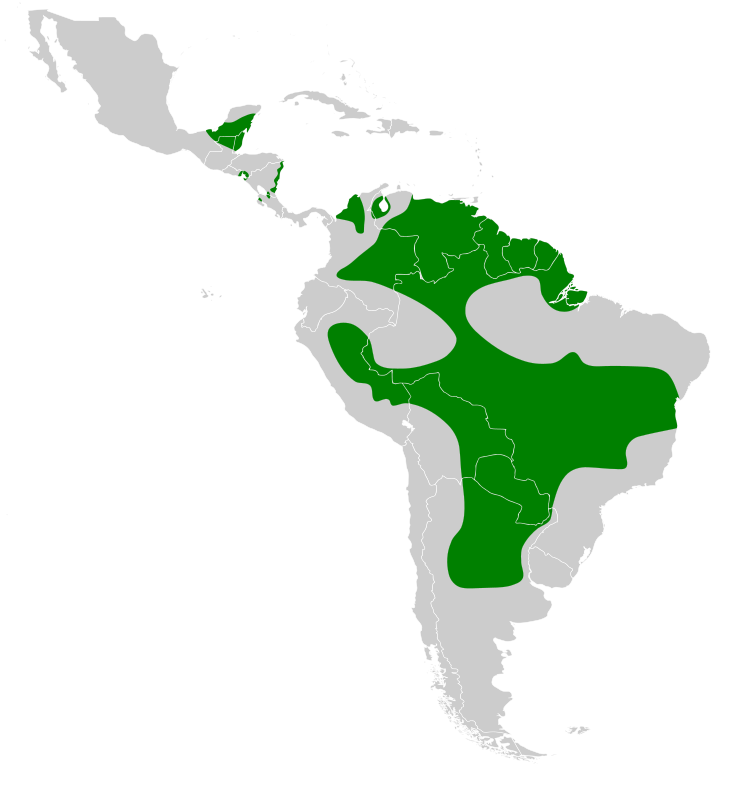
Data retrieved on September 27, 2026 at 5:42 PM