 Bird App
Bird of the day
Black-capped chickadee
Poecile atricapillus
The black-capped chickadee (Poecile atricapillus) is a small, nonmigratory, North American passerine bird that lives in deciduous and mixed forests. It is a member of the Paridae family, also known as tits. It has a distinct black cap on its head, a black bib underneath, and white cheeks. It has a white belly, buff sides, and grey wings, back, and tail. The bird is well known for its vocalizations, including its fee-bee song and its chick-a-dee-dee-dee call, from which it derives its name.
The black-capped chickadee is widely distributed throughout North America, ranging from the northern United States to southern Canada and all the way up to Alaska and Yukon. It feeds primarily on insects and seeds, and is known for its ability to cache food for use during the winter. The hippocampus of the black-capped chickadee grows during the caching season, which is believed to help it better remember its cache locations. The black-capped chickadee is a social bird and forms strict dominance hierarchies within its flock. During the winter, these flocks include other bird species. It has the ability to lower its body temperature during cold winter nights, allowing it to conserve energy.
Black-capped chickadees build nests in tree cavities, with the nesting season starting in late April and lasting until late June. They lay on average 6–8 eggs, which hatch after 11–14 days. Juveniles fledge 12–16 days after hatching.
The population of black-capped chickadees is thought to be increasing, and they are considered a species of least concern by the International Union for Conservation of Nature (IUCN). It is the state bird of both Massachusetts and Maine in the United States, and the provincial bird of New Brunswick in Canada.
The black-capped chickadee has a black cap and "bib" with white cheeks. Its underparts are white with buff-colored flanks. Its back is unstreaked and greenish gray, and the tail and wings are slate gray. It has a black beak and legs, and dark brown irises. Males and females are generally similar, although males have a larger bib. They can also be distinguished based on a combination of weight and tail length. Tarsus length does not significantly differentiate sexes. Males have a wing length of 63.5–67.5 mm (2.50–2.66 in), a tail length of 58–63 mm (2.3–2.5 in), a bill length of 8–9.5 mm (0.31–0.37 in), and a tarsus length of 16–17 mm (0.63–0.67 in). Females are on average slightly smaller, with a wing length of 60.5–66.5 mm (2.38–2.62 in), a tail length of 56.3–63 mm (2.22–2.48 in), a bill length of 9–9.5 mm (0.35–0.37 in), and a tarsus length of 16–17 mm (0.63–0.67 in). Both sexes weigh 10–14 g (0.35–0.49 oz). Juveniles are visually similar to adults but with fluffier plumage.
Although range can generally be used to separate them, the black-capped chickadee is very similar in appearance to the Carolina chickadee. The edges of the wings are somewhat paler than the Carolina chickadee, and the bib of the black-capped chickadee has a "messier" border than the Carolina chickadee. The most reliable way to distinguish the two species is by vocalizations. Black-capped chickadees have a slower, hoarser, two-part song, whereas Carolina chickadees have a three-part song.
Black-capped chickadees are also somewhat similar to mountain chickadees and boreal chickadees. Mountain chickadees can be distinguished by a distinct white stripe above their eyes, and boreal chickadees have a brown cap as opposed to the black cap of the black-capped chickadee.
The vocalizations of the black-capped chickadee are highly complex, with 16 distinct types of vocalizations being used to convey an array of information. These vocalizations are likely an evolutionary adaptation to their habitat; they live and feed in dense vegetation, and even when the flock is close together, individual birds tend to be out of each other's visual range.
One of the most recognizable sounds produced, particularly by the males, is the two-note fee-bee song. It is a simple, clear whistle of two notes, identical in rhythm, the first roughly a whole-step above the second.
The frequency of their songs typically starts around 400 Hz, and various tones spanning roughly 1 kHz are sung within the song. A decrease of roughly 200 Hz occurs when the first note (fee) is sung, and then another decrease around 400 Hz takes place between the end of fee and the beginning of bee. In spite of these multiple changes in frequency, though, anybody listening to the song only hears a pure, high-frequency tone. This is distinguished from the Carolina chickadee's four-note call fee-bee fee-bay; the lower notes are nearly identical but the higher fee notes are omitted, making the black-capped song like bee bay. The males sing the song only in relative isolation from other chickadees (including their mates). In late summer, some young birds sing only a single note.
Both sexes sometimes make a faint version of the fee-bee song, and this appears to be used when feeding young. During breeding, the male may make this call to attempt to attract a female. During nesting, this call is used by both sexes to call to their partner when not in sight. Distinguishing males and females based solely on their singing is difficult. A bioacoustic analysis performed on both male and female songs revealed that male fee-bee singing fluctuates more, and the absolute amplitude of both sexes is the same.
The most familiar call is the chick-a-dee-dee-dee, which gave this bird its name. This simple-sounding call is astonishingly complex. Scientists have been studying it since the mid-1970s. It is produced by both males and females year-round. It has been observed to consist of up to four distinct units—referred to as A, B, C, and D. A, B, and C are variations of the "chick-a" part of the call, and D is the repeated "dee". These can be arranged in different patterns to communicate information about threats from predators and coordination of group movement. These four notes only ever appear in this consecutive order with each preceding note blending into the next; however, not all four notes always appear in the call. Like other sounds the chickadee produces, it may be heard in multiple variations. The A and B notes are almost identical to one another in both frequency and duration, though black-capped chickadees possess the ability to quickly notice the difference between these two notes. No such similarity is seen between the C and D notes. The C note fluctuates from low to high then back to low, whereas the D note has a constant frequency. While not confirmed, one study found evidence of a function behind the C and D notes: the C note is used indicate the location of food, and the D note is used to distinguish between a member of the same species and a potential predator.
Neither individual notes nor groups of notes have an equal probability of appearing in the chick-a-dee-dee-dee song. Its syntax form may take on several different structures, but the two most commonly heard are [A][D] and [B][C][D]. Calls containing the D note are most frequently heard. A study of the call showed that the number of dees indicates the level of threat from nearby predators. In an analysis of over 5,000 alarm calls from chickadees, alarm calls triggered by small, dangerous raptors had a shorter interval between chick and dee and tended to have extra dees, typically four instead of two. In one case, a warning call about a pygmy owl—a prime threat to chickadees—contained 23 dees. The Carolina chickadee makes a similar call, which is faster and higher-pitched.
Other species have also been observed making use of these chick-a-dee-dee-dee alarm calls. During the non-breeding season, mixed species flocks may form to help with foraging and predator avoidance, and may include nuthatches, woodpeckers, kinglets, and vireos among others. These species will react when a chickadee makes the alarm call. Red-breasted nuthatch have even been observed reacting more strongly to higher-threat alarm calls, indicating some understanding of their syntax.
Black-capped chickadees make a number of other calls and sounds, such as a gargle noise usually used by males to indicate a threat of attacking another male, often when feeding. This call is also used in sexual contexts. Black-capped chickadees learn the gargle noise soon after birth and continues to develop it through to adulthood. This noise is among the most complex of the calls; in one population of chickadees, the gargle contained 2 to 9 instances of 14 distinct notes, all sung within half a second.
Social learning in particular is largely influential to the development of the gargle. Beginning 30 to 35 days after birth, strings of low-amplitude precursor or sub-gargles are produced for about a minute. At this time, they learn to produce such sounds by listening to their parents and siblings. Three chickadee populations were observed at three different sites over 8 years, and all of them produced vocalizations that were very similar to one another. Strings of juvenile sub-gargles are almost perfectly continuous and both low and unstable in frequency, yet lacking multiple syllables. When their vocal abilities are fully developed, a stable frequency is produced and a variety of syllables is heard that vary in length.
Other calls which have been noted include a "broken dee", "variable see", hiss, snarl twitter, "high zee", and tseet. Some of these calls are used during breeding to attract a mate or reinforce a pair bond, such as the "broken dee" and "variable see". Others, such as the snarl and twitter, are used territorially.
Black-capped chickadees in an environment with ambient noise at the same frequencies as their songs are able to adjust the frequency of their songs to effectively communicate with the surrounding population. When interacting with other chickadees close by, the males matched their frequencies; however, when the surrounding environment was noisy with other species, the males adapted by increasing the frequency of their songs. Another survey, though, showed that male chickadees sometimes intentionally match the tones of competing chickadees as a way of showing aggression. Dominant males in a population often compete with lower-ranked males, and singing contests are a way male chickadees decide who gets to mate. When a male loses a contest, particularly a higher-ranking male in the population, he will often have difficulty finding a mate.
Aliases
Poecile atricapillus, willow tit
Range
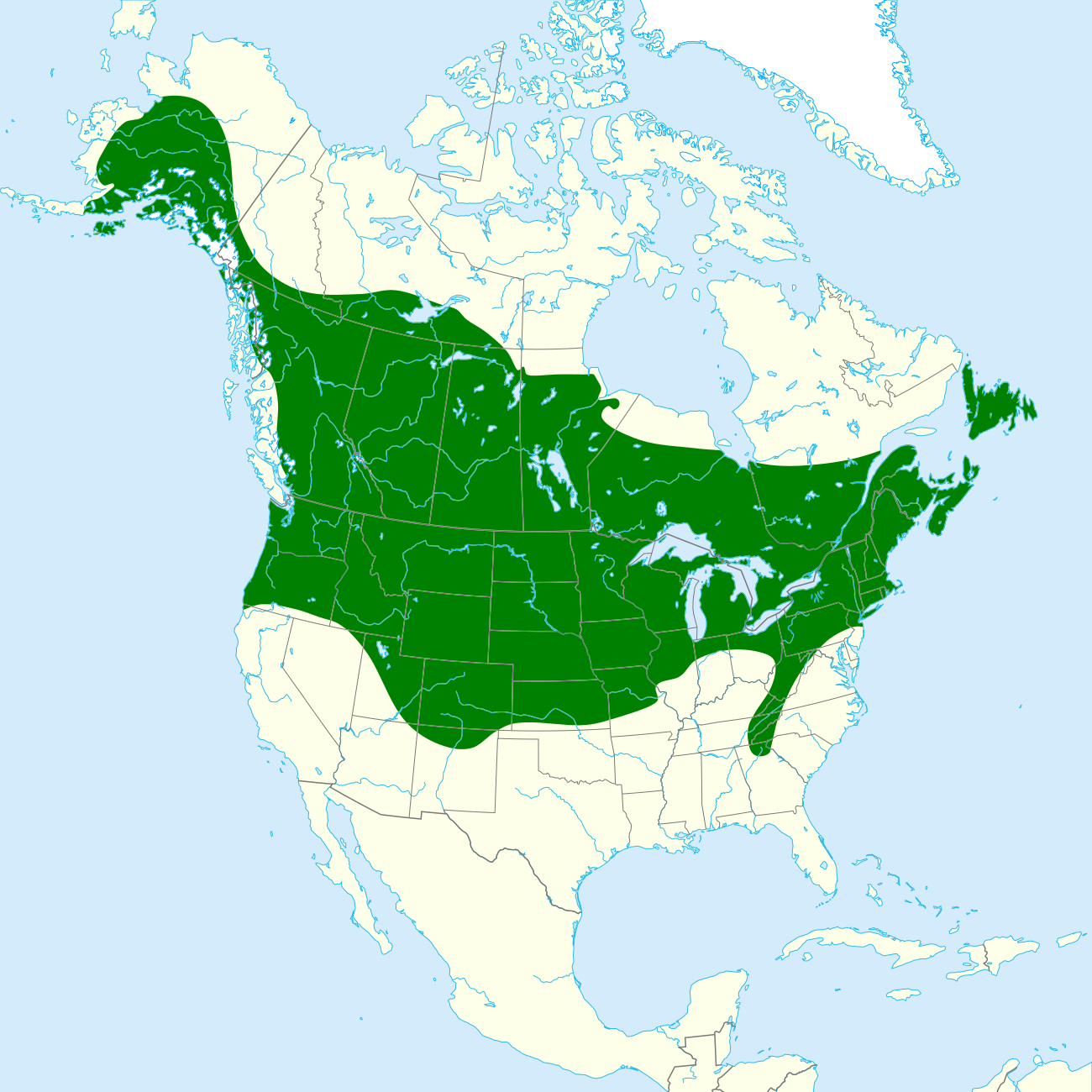
Data retrieved on October 15, 2025 at 5:14 AM