 Bird App
Bird of the day
Mangrove swallow
Tachycineta albilinea
The mangrove swallow (Tachycineta albilinea) is a passerine bird in the swallow family that breeds in coastal regions from Mexico through Central America to Panama. It has blue-green upperparts, blackish flight feathers, a white rump, a black tail, and white underparts. It can be identified by the supraloral white streak, the white line near its eye, which only occurs in two other species of Tachycineta: the violet-green swallow and the white-rumped swallow. The sexes, although similar in plumage, differ slightly in size. The juveniles have grey-brown upperparts and white-washed underparts. This swallow's song is generally described as a soft trilling, with a rolled jeerrt call, and a sharp alarm note.
The mangrove swallow is very territorial when breeding, much like the related tree swallow. Its nest is normally built in a hole or crevice near water and less than 2 metres (7 ft) above the ground. This species usually feeds alone when breeding, but will feed in groups when not. It normally forages closer to the nest when hunting for its chicks, but will go much further when foraging for itself. In between foraging attempts, it is frequently seen perching near water. It is an aerial insectivore and eats unusually large prey for its size.
With an estimated population of at least 500,000 individuals, the mangrove swallow is classified as a species of least concern by the International Union for Conservation of Nature (IUCN). Its numbers are decreasing, although not fast enough for it to be classified as vulnerable. Little is known about the predation of this species, although it is a host of Sternostoma hirundinis, a type of nasal mite. It has also been known to lose nests both to termites and black flies.
A relatively small swallow, the mangrove swallow is 11–12 centimetres (4.3–4.7 in) long and weighs about 14 grams (0.5 oz). The adult has iridescent blue-green upperparts, white underparts, rump, and undertail- and wing-coverts, and blackish tail and flight feathers. The feathers are greener when fresh and bluer when worn. The white underparts sometimes have faint, dark shaft streaks. The bill is small and black, about 11 millimetres (0.43 in) long. The iris is a dark brown, and the tarsus and toes range in colour from black to fuscous-brown. The lores are black and have a thin white line above them. Two other species of Tachycineta have this distinctive feature: the violet-green swallow and the white-rumped swallow. The adult's tail is only slightly forked. The sexes are similar, although they differ slightly in size. Compared to the male, the female has a slightly longer tail and slightly shorter wings. The juvenile is dull grey-brown above and grey-brown washed white below. Occasionally, the juvenile's upperparts have a subtle, greenish gloss.
The call of the mangrove swallow is a rolled "jeerrrt", or a "chriet". The song is frequently described as a soft trilling. It uses a short sharp alarm note.
Aliases
Tachycineta albilinea
Range
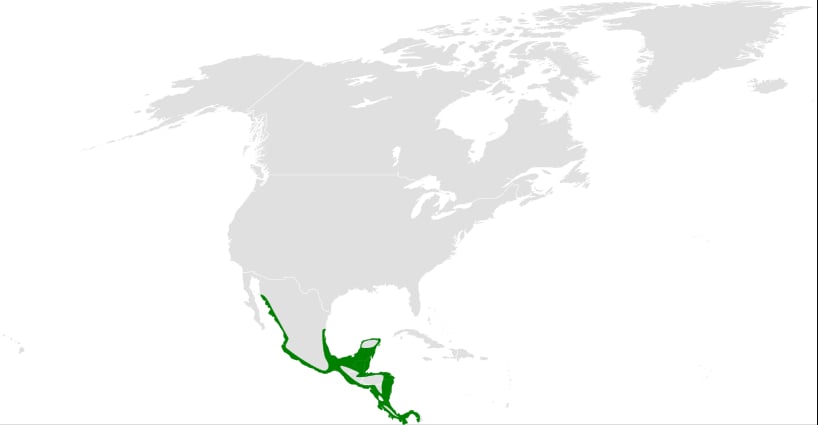
Data retrieved on October 15, 2025 at 5:13 AM