 Bird App
Bird of the day
American goldfinch
Spinus tristis
The American goldfinch (Spinus tristis) is a small North American bird in the finch family. It is migratory, ranging from mid-Alberta to North Carolina during the breeding season, and from just south of the Canada–United States border to Mexico during the winter.
The only finch in its subfamily to undergo a complete molt, the American goldfinch displays sexual dichromatism: the male is a vibrant yellow in the summer and an olive color during the winter, while the female is a dull yellow-brown shade which brightens only slightly during the summer. The male displays brightly colored plumage during the breeding season to attract a mate.
The American goldfinch is a granivore and adapted for the consumption of seedheads, with a conical beak to remove the seeds and agile feet to grip the stems of seedheads while feeding. It is a social bird and will gather in large flocks while feeding and migrating. It may behave territorially during nest construction, but this aggression is short-lived. Its breeding season is tied to the peak of food supply, beginning in late July, which is relatively late in the year for a finch. This species is generally monogamous and produces one brood each year.
Human activity has generally benefited the American goldfinch. It is often found in residential areas because it is attracted to bird feeders, which increase its survival rate in these areas. Deforestation also creates open meadow areas, which are its preferred habitat.
The American goldfinch is a small finch, 11–14 cm (4.3–5.5 in) long, with a wingspan of 19–22 cm (7.5–8.7 in). It weighs between 11–20 g (0.39–0.71 oz). Among standard measurements, the wing chord is 6.5 to 7.8 cm (2.6 to 3.1 in), the tail is 4.2 to 5.1 cm (1.7 to 2.0 in), the culmen is 0.9 to 1.1 cm (0.35 to 0.43 in) and the tarsus is 1.2 to 1.4 cm (0.47 to 0.55 in). The beak is small, conical, and pink for most of the year, but turns bright orange with the spring molt in both sexes.
The shape and size of the beak aid in the extraction of seeds from the seed heads of thistles, sunflowers, and other plants.
The American goldfinch undergoes a molt in the spring and autumn. It is the only cardueline finch to undergo molting twice a year. During the winter molt it sheds all its feathers; in the spring, it sheds all but the wing and tail feathers, which are dark brown in the female and black in the male. The markings on these feathers remain through each molt, with bars on the wings and white under and at the edges of the short, notched tail. The sexual dimorphism displayed in plumage coloration is especially pronounced after the spring molt, when the bright color of the male's summer plumage is needed to attract a mate.
Once the spring molt is complete, the body of the male is a brilliant lemon yellow, a color produced by carotenoid pigments from plant materials in its diet, with a striking jet black cap and white rump that is visible during flight. The female is mostly brown, lighter on the underside with a yellow bib. After the autumn molt, the bright summer feathers are replaced by duller plumage, becoming buff below and olive-brown above, with a pale yellow face and bib. The autumn plumage is almost identical in both sexes, but the male has yellow shoulder patches.
The immature bird has a dull brown back, and the underside is pale yellow. The shoulders and tail are a dull black with buff-colored, rather than white, markings on wings and rump. This coloration is the same in both sexes.
The song is a series of musical warbles and twitters, often with a long note. A tsee-tsi-tsi-tsit call is often given in flight; it may also be described as per-chic-o-ree. While the female incubates the eggs, she calls to her returning mate with a soft continuous tee-tee-tee-tee-tee sound. The young begin to use a call of chick-kee or chick-wee shortly before fledging, which they use until they have left the nest entirely. There are two defense calls made by adults during nesting; a sweet call made to rally other goldfinches to the nest and distract predators, and a bearbee used to signal to the nestlings to quiet them and get them to crouch down in the nest to become less conspicuous.
Aliases
Spinus tristis
Range
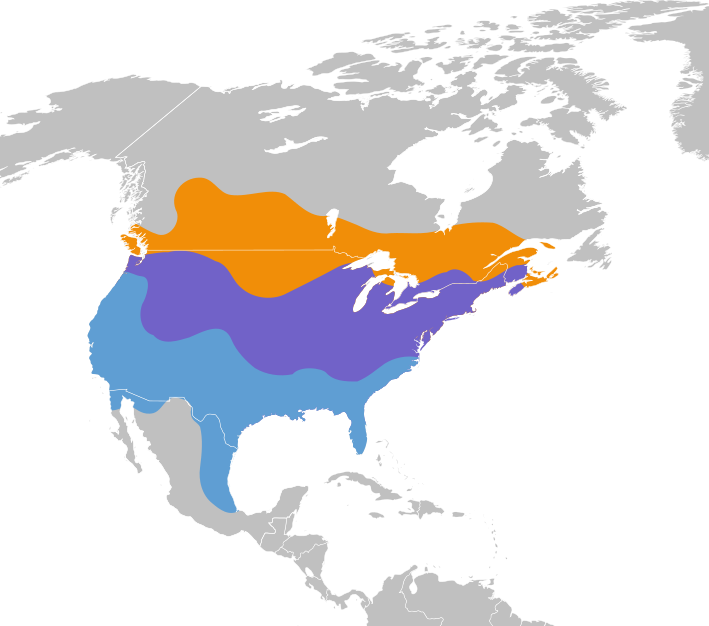
Data retrieved on October 15, 2025 at 5:12 AM