 Bird App
Bird of the day
Cinereous vulture
Aegypius monachus
The cinereous vulture (Aegypius monachus), also known as the black vulture, Eurasian black vulture, and monk vulture, is a very large raptor in the family Accipitridae distributed through much of temperate Eurasia. With a body length of 1.2 m (3 ft 11 in), 3.1 m (10 ft) across the wings and a maximum weight of 14 kg (31 lb), it is the largest Old World vulture and largest member of the family Accipitridae.
Aegypius monachus is one of the largest birds of prey and it plays a huge role in its various ecosystems by eating carcasses, which in turn reduces the spread of diseases. The vultures are constantly exposed to many pathogens because of their eating carrion. A study of the gastric and immune defense systems conducted in 2015 sequenced the bird's entire genome. The study compared cinereous vultures to bald eagles, finding positively selected genetic variations associated with respiration and the ability of the vulture's immune defense responses and gastric acid secretion to digest carcasses.
The cinereous vulture measures 98–120 cm (39–47 in) in total length with a 2.5–3.1 m (8 ft 2 in – 10 ft 2 in) wingspan. Males can weigh from 6.3 to 11.5 kg (14 to 25 lb), whereas females can weigh from 7.5 to 14 kg (17 to 31 lb). It is the largest accipitrid and is thus one of the world's heaviest flying birds. Average weights were long not known to have been published for this species but the median weight figures from two sources were 9.42 kg (20.8 lb) and 9.55 kg (21.1 lb). However in a Korean study, a large survey of wild cinereous vultures was found to have weighed an average of 9.6 kg (21 lb) with a mean total length of 113 cm (44 in), this standing as the only attempt to attain the average sizes of free-flying mature birds of the species, as opposed to nestlings or captive specimens. Unlike most accipitrids, males can broadly overlap in size with the females, although not uncommonly the females may be slightly heavier. These are one of the two largest extant Old World vultures and accipitrids, with similar total length and perhaps wingspans recorded in the Himalayan vulture (Gyps himalayensis), as indicated by broadly similar wing and tail proportions, but the cinereous appears to be slightly heavier as well as slightly larger in tarsus and bill length. Superficially similar but only distantly related New World condors can either be of similar wing area and bulk or slightly larger in these aspects. Despite limited genetic variation in the species, body size increases from west to east based on standard measurements, with the birds from southwest Europe (Spain and south France) averaging about 10% smaller than the vultures from central Asia (Manchuria, Mongolia and northern China). Among standard measurements, the wing chord is 73–89 cm (29–35 in), the tail is 33–41 cm (13–16 in) and the tarsus is 12–14.6 cm (4.7–5.7 in).
The cinereous vulture is distinctly dark, with the whole body being dark blackish-brown excepting the pale head in adults, which is covered in fine blackish down. This down is absent in the closely related lappet-faced vulture (Torgos tracheliotos). The skin of the head and neck is bluish-grey and a paler whitish colour above the eye. The adult has brown eyes, a purplish cere, a blue-grey bill and pale blue-grey legs. The primary quills are often actually black. From a distance, flying birds can easily appear all black. The immature plumage is sepia-brown above, with a much paler underside than in adults. Immature cinereous vultures have grey down on the head, a pale mauve cere and grey legs. Its massive bill is one of the largest of any living accipitrid, a feature enhanced by the relatively small skull of the species. The exposed culmen measures 8–9 cm (3.1–3.5 in). Only their cousin, the lappet-faced vulture, with a bill length of up to about 10 cm (3.9 in), can rival or outsize the bill of the cinereous. The wings, with serrated leading edges, are held straight or slightly arched in flight and are broad, sometimes referred to as "barn door wings". Its flight is slow and buoyant, with deep, heavy flaps when necessary. The combination of huge size and dark colour renders it relatively distinct, especially against smaller raptors such as eagles or buzzards. The most similar-shaped species, the lappet-faced vulture (with which there might be limited range overlap in the southern Middle East), is distinguished by its bare, pinkish head and contrasting plumage. On the lappet-face, the thighs and belly are whitish in adult birds against black to brownish over the remainder of the plumage. All potential Gyps vultures are distinguished by having paler, often streaky plumage, with bulging wing primaries giving them a less evenly broad-winged form. Cinereous vultures are generally very silent, with a few querulous mewing, roaring or guttural cries solely between adults and their offspring at the nest site.
Aliases
Aegypius monachus, Eurasian black vulture, black vulture, monk vulture, cinereous vulture
Range
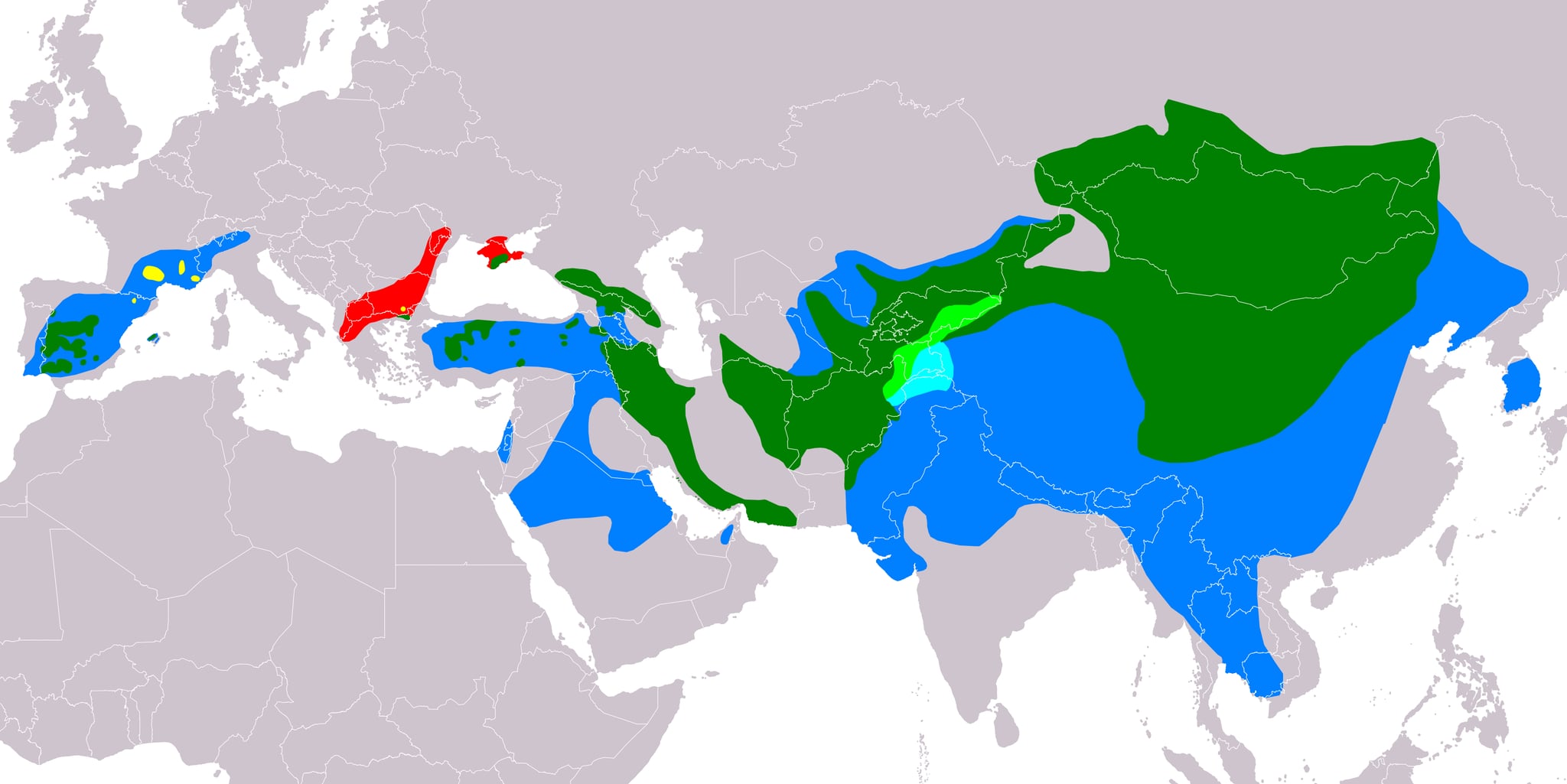
Data retrieved on October 15, 2025 at 5:06 AM